South Africa · In development
One aircraft, designed properly.
Drone SA is building a patrol drone for South African farms, estates, mines and industrial sites. We are at the start: the design specification is done, and the first prototypes are planned for 2027.
01 / Why
Built for a South African working week.
Most patrol drones sold here are imported, priced for other markets and supported from overseas. When something breaks, the aircraft waits for parts.
We want to build one designed for local conditions: dust, heat, Highveld altitude and night patrols. It should be repairable here, and come with the documents an operator needs for SACAA approval.
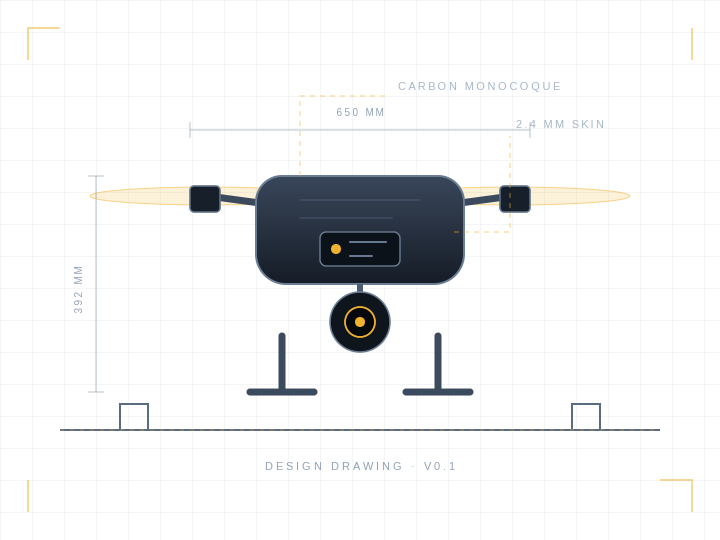
The Nightjar is deliberately a single aircraft rather than a catalogue: one airframe, one payload and one set of documents, built around a flight controller board we design ourselves.
Why "Nightjar"
Named after a bird that works the night shift.
Nightjars are South African birds that work at night. They fly quietly, are almost invisible against the ground, and rest on bare ground by day.
That is the job we are designing the drone for: patrol at night, stay quiet, and rest on its Roost pod on the ground between flights. The Fiery-necked Nightjar's call is one of the best-known night sounds of the South African bush.
02 / Roadmap
Where we are, and what comes next.
Each step has a test the aircraft must pass before the next one starts. Dates after 2027 depend on those tests.
Design specification v0.1
Mission, airframe, propulsion, avionics, payload, radio and SACAA compliance defined. Done in November 2026.
Bench work and first prototypes
Thrust-stand tests, the first flight controller board, and the first prototype airframes flying.
Field trials
Night trials with a small group of pilot customers, to measure endurance and detection range for real.
First production aircraft
A small first batch, once the trials pass and the cost target is met.
03 / How we work
Four rules we design to.
Repairable beats disposable
Every structural part should be replaceable with hand tools in the field. Serviceability is a design requirement, not an afterthought.
Honest specifications
Every figure on this site is a design target until we have flown it. When we have measured numbers, we will publish them with the conditions attached.
Local support
The aim is spares and repairs in South Africa, not a six-week wait on an import.
Tell the customer the truth
If the mission does not need a drone, or a quad is the wrong tool for a long corridor, we will say so.
04 / Compliance
Designed around Part 101.
South African drone law is strict. Three points from Part 101 shape the aircraft itself.
A pilot stays in the loop. Part 101 does not cover autonomous aircraft that cannot be managed in real time. The Nightjar is designed for automated patrols with live pilot override, never “fully autonomous” flight.
Night flying needs approval. Under regulation 101.05.12, night operation needs the Director's approval for that aircraft on the operator's OpSpec. The Nightjar is being designed with navigation and anti-collision lighting, and with documentation to support that application.
Every aircraft is registered. Each unit will have a unique serial number and its own data pack, so it can be registered and added to an operator's certificate.
Per-aircraft data pack (planned)
Specifications, flight manual, maintenance manual and schedule, mass and balance, test-flight report and firmware version, for each serial number.
Radio & spectrum
We plan to use links in the 2.4 GHz and 5.8 GHz bands. We are confirming the current ICASA power limits and type-approval requirements for each radio before anything is sold.
Prototypes in 2027
Help us test it on a real site.
We are looking for farms, estates and security operators to join the pilot programme during field trials.