Drone SA South Africa
Nightjar Technology Simulator Missions Pilot programme About Contact Register interest

Nightjar · 4.7 kg patrol quadcopter

The Nightjar.

One airframe, one payload, one job: see a person or a vehicle at night, hold position over them, and hand the operator evidence they can use the next morning. Everything below is the v0.1 design specification. No Nightjar has flown yet; prototypes are planned for 2027.

Target price under R100 000 incl. VAT Prototypes in 2027 SACAA Part 101 data pack planned
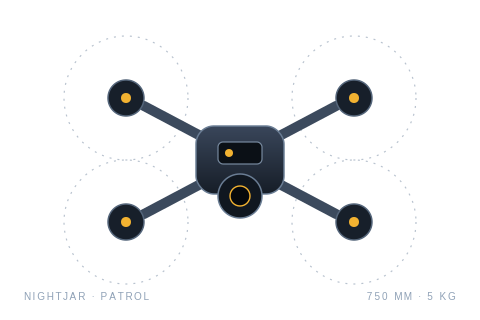
Nightjar patrol quadcopter outline

Nightjar In design

A quadcopter that earns its keep on a fence line.

Patrol work is mostly hovering and staring at one spot, which a quadcopter does efficiently and a fixed wing does badly. The Nightjar is built around that: large slow props for quiet hover, a battery pack sized for a full perimeter loop with reserve, and a gimbal mounted front-under so the props never cross the camera.

The airframe is designed to fold into a double-cab boot, with a battery that swaps from the top without tools and arms that are field-replaceable carbon tubes. The target is case to airborne in under five minutes.

Layout
Quad X, folding arms
Motor to motor
750 mm
MTOM
4.7 kg target / 5.0 kg max
Endurance
37 min sea level · 33 min Highveld (calculated)
Payload
384×288 thermal + 2K daylight
Price
Target under R100 000 incl. VAT

01 / Specification

The numbers, without the marketing.

Endurance figures are estimates from the hover-power model. They will be tested on the thrust stand and in flight once the prototypes are built in 2027.

Airframe

Layout
Quad X, folding
Motor to motor
750 mm
Props
15–16″ carbon
MTOM
4.7 kg
Ingress
IP43
Wind
10 m/s gusting 15
Temperature
−5 to +45 °C
Density altitude
2 500 m
Set-up
< 5 min, two people

Propulsion & power

Motors
4× 41xx, 380–400 KV
Thrust
≥ 2.4 kg each
Thrust / weight
≥ 2:1 at sea level
ESCs
40–60 A FOC, DroneCAN
Battery
6S4P Li-ion, 389 Wh
Battery mass
≈ 1.7 kg
Endurance
37 min (33 min Highveld), calculated
Charging
BMS stops above 45 °C
Swap
Top-loading, tool-free

Avionics

Flight controller
Drone SA PCB
MCU
STM32H743
Firmware
PX4
IMUs
2, separate SPI buses
Barometer
BMP390 class
GNSS
2× M10 class + mag mast
Companion
RK3588 / CM5, 6 TOPS NPU
Interfaces
2× CAN, Ethernet, UART
Logs
microSD, per flight

Payload & link

Gimbal
3-axis, front-under
Thermal
384 × 288, 7 mm lens
Field of view
24.8° × 18.7°
Daylight
2K
Detection
150 m person / 400 m vehicle (targets)
Video
RTSP over Ethernet
Link
Integrated digital, 1080p
Range
5 km reliable
Lights
Nav + anti-collision strobe

How it’s engineered

02 / Detection

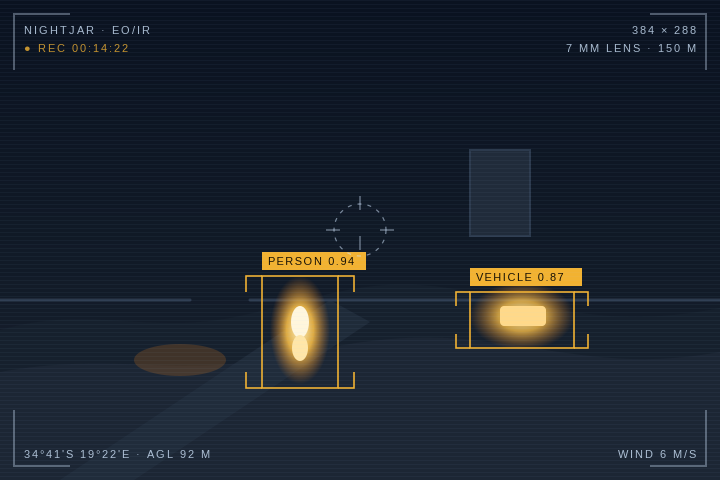
What 150 metres actually looks like.

At 150 m a 384×288 thermal core puts roughly 17 cm on each pixel. A person is about three pixels across — enough to detect, not enough to identify. Switch to the Pro's 640×512 core and that distance roughly doubles.

Detect — a warm body against a cool background. About 3 pixels, roughly 150 m on the v1 core.

Recognise — person or animal, and roughly how many. About 6 pixels, roughly 75 m.

Confirm — daylight camera, zoomed. The thermal finds it, the 2K camera identifies it.

Detection ranges are design targets from the v0.1 specification and are will be tested in night flight trials with the 2027 prototypes. We will publish measured numbers, not brochure numbers.

Thermal camera frame showing a detected person and vehicle with bounding boxes

03 / Safety

Fail-safes, and a pilot who stays in charge.

Part 101 does not cover aircraft that cannot be managed in real time, so we sell automated patrols with live pilot override — never “fully autonomous”. Every Nightjar has a pilot on the controls and a defined response for each failure.

Configured in firmware and documented in the flight manual.
EventAircraft response
Control link lostHover 5 s, then return to home at a safe altitude
Low batteryReturn-to-home threshold computed from distance, wind and reserve — not a fixed percentage
Critical batteryLand immediately at the current position
Geofence breachStop at the boundary, then return to home
GNSS lostHold altitude on optical flow if fitted; otherwise pilot-controlled flight and land
IMU disagreementSwitch to the healthy IMU — two independent IMUs on separate buses
Motor failureA quad cannot survive this. Optional parachute; a six-rotor Pro variant is under consideration

Night operations

Lights, and the approval

Navigation and anti-collision strobe lighting built in, because night flying needs the Director's approval on your OpSpec under regulation 101.05.12 — and the aircraft has to be equipped for it.

Registration

A serial number per unit

Every aircraft has a unique serial and its own data pack, so it can be registered and attached to your operator certificate without a fight.

Records

Logs you have to keep anyway

Flight logs record pilot, aircraft, route and duration. The app exports them in the form a Part 101 operator already has to maintain.

04 / In the case

The data pack is the product.

Imported aircraft arrive with a manual written for a different regulator. Every Nightjar will ship with the documents a South African operator needs, in a folder your safety officer can hand to an inspector.

01
Flight manual & checklistsNormal, abnormal and emergency procedures for this airframe.
02
Maintenance manual & scheduleInspection intervals, torque values and replacement parts.
03
Mass & balance, test-flight reportSerial-specific acceptance evidence from the flight test.
04
Firmware version & configurationExactly what was loaded, so the aircraft stays traceable.
Nightjar Pro airframe outline

Nightjar Pro Planned

Same aircraft. Twice the eyes.

The Pro keeps the airframe, the avionics and the batteries, and swaps the payload for a 640×512 thermal core with a 4K daylight camera. That roughly doubles detection and recognition distance, which matters on large farms and mine boundaries.

It is also planned to add an optional parachute and an LTE backup link for fleet monitoring. It is not for sale yet and comes after the standard Nightjar.

Thermal
640 × 512
Daylight
4K, 3-axis gimbal
Detection
≈ 300 m person (target)
Options
Parachute, LTE backup
Status
Planned
Price
On application

05 / Longer term

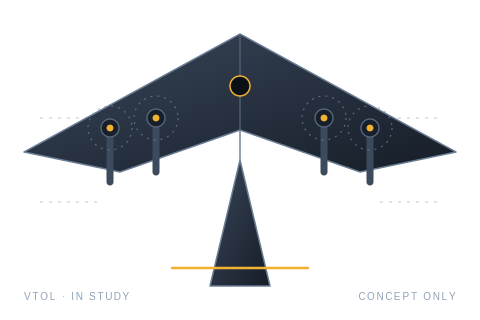
Why not a VTOL yet?

A fixed-wing VTOL flies two to three times longer in forward flight, and for a long pipeline or a very large farm that is the right tool. It also hovers poorly, needs tilt or lift motors and control surfaces, and is much harder to tune — a lot of risk to carry alongside a new flight controller.

So it stays a study. If your site is measured in tens of kilometres rather than hectares, tell us: it is the fastest way to move it up the list.

Tell us about your site

VTOL study aircraft outline

Side by side

The three aircraft, honestly.

All figures are design targets; nothing has been flight-tested yet. Pro and VTOL figures are provisional.
Specification Nightjar Nightjar Pro VTOL (study)
ClassQuadcopterQuadcopterVTOL fixed wing
StatusIn designPlannedIdea
MTOM4.7 kg≈ 5 kg—
Endurance37 min—2–3× the quad
Thermal384 × 288640 × 512—
Daylight2K4K—
Person detection150 m≈ 300 m—
Link range5 km5 km + LTE—
HoverEfficientEfficientPoor — forward flight only
IngressIP43IP43—
Price (incl. VAT)Under R100 000 (target)Not set—
AvailabilityPrototypes 2027After NightjarNot scheduled

Planned for every aircraft

Support that fits on a bakkie.

The aircraft is being designed to be repairable: arms are tubes, the shell is a moulded part, and the boards are ours. The aim is local spares instead of a six-week wait on an import. Support terms will be set before the first aircraft is sold.

01
Two days of operator trainingOn your site, at night, with your routes and your crew.
02
Spares kitProps, arms, battery and gimbal spares held locally.
03
Annual service & calibrationSensor recalibration and firmware updates (planned).
04
Airframe warrantyTerms to be confirmed before launch.

Target price under R100 000 · Prototypes in 2027

Follow the build.

Prototypes fly in 2027. Register interest for updates, or apply to join the pilot programme and test the Nightjar on your own site during field trials.